Table of Contents
If your mind races the moment your head hits the pillow, or your shoulders live somewhere up around your ears, you already know that stress is not just "in your head" — it lives in the body too. The good news is that this is exactly where yoga is quietly brilliant. Yoga for anxiety and stress relief is not about twisting into a pretzel; it is about using breath and gentle movement to tell your nervous system, over and over, that you are safe.
This guide skips the fluff and gives you practices you can actually use tonight — a few breathing techniques, eight calming poses, and a short routine to wind down. None of it requires flexibility, special equipment, or even leaving your bedroom floor.
Why Yoga Calms Anxiety and Stress
When you feel anxious, your body flips into "fight or flight" — the sympathetic nervous system floods you with adrenaline and cortisol, your heart speeds up, and your breath goes shallow. It is useful if you are running from danger, and exhausting if you are just trying to answer emails.
Yoga works because it deliberately switches on the opposite system: the parasympathetic, or "rest and digest," state. Slow breathing, long exhales and gentle holds stimulate the vagus nerve, lower your heart rate, and signal to the brain that the threat has passed. Do it regularly and you are not just relaxing for ten minutes — you are training your body to return to calm more easily the rest of the time. That is why yoga for stress relief tends to work better as a small daily habit than as a rare, heroic session.
It Starts With the Breath
If you only take one thing from this article, take this: the breath is the fastest remote control for your nervous system. Long, slow exhales are the single most reliable way to calm anxiety in the moment. Try these three, in order of gentleness.
- Extended exhale. Breathe in for a count of four, out for a count of six or eight. Making the out-breath longer than the in-breath is what flips the calm switch. Do it for two minutes.
- Box breathing. Inhale for four, hold for four, exhale for four, hold for four. Steady and grounding, great before a stressful meeting.
- Alternate nostril breathing (Nadi Shodhana). Gently close one nostril, breathe in; switch, breathe out; and continue. Wonderful for a busy, scattered mind.
These breathing techniques are the heart of pranayama, and they are worth learning properly. If you would like to go deeper, our guide to the benefits of pranayama breaks each one down step by step.
A 60-Second Reset for Right Now
Wherever you are, soften your shoulders, unclench your jaw, and breathe in for four and out for eight — just five slow rounds. Notice how the edges of the anxiety soften. That is your nervous system responding in real time.
8 Calming Poses to Try
These are gentle, grounding shapes chosen specifically to soothe rather than energise. Move slowly, breathe long, and stay in each for several breaths or a few minutes.
| Pose | Why It Helps |
|---|---|
| Child's Pose (Balasana) | Turns attention inward and gently signals safety |
| Legs-Up-the-Wall (Viparita Karani) | Calms the heart rate and eases tired legs and mind |
| Cat-Cow (Marjaryasana-Bitilasana) | Links breath to movement, releasing the spine and shoulders |
| Standing Forward Fold (Uttanasana) | Releases the neck and lets the head hang, quieting thoughts |
| Supported Bridge | Opens the chest where we hold tension, with support underneath |
| Reclined Twist | Wrings out the spine and settles the belly |
| Reclined Bound Angle (Supta Baddha Konasana) | A deeply restful heart and hip opener |
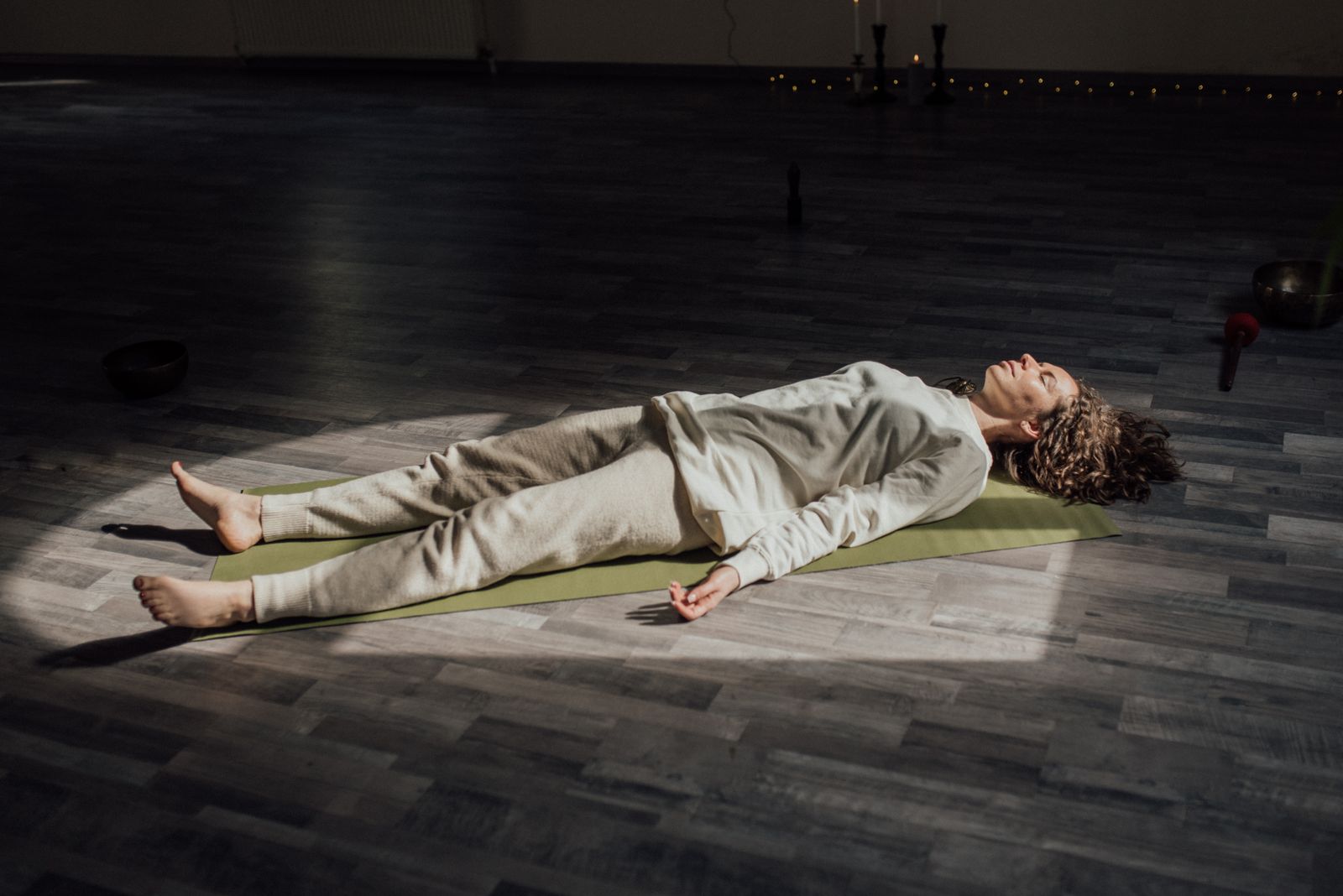
| Savasana (Corpse Pose) | Full-body rest that lets everything you practised sink in |
Notice that most of these are done lying down or close to the floor. That is intentional — when the body is fully supported, the mind is far more willing to let go.
The Rise of Restorative and Yin Yoga
For years, yoga culture chased sweat and intensity. The shift now is unmistakably toward slowing down. Restorative and Yin yoga — long, softly held poses supported by props — have become some of the most sought-after styles precisely because so many of us are overstimulated and under-rested. This is yoga for stress and anxiety at its purest: less doing, more being.
If you love that quiet, floaty feeling at the end of a class, you will also love Yoga Nidra, a guided "yogic sleep" practice that is remarkably effective for anxiety and insomnia. Twenty minutes can feel like a deep reset.
A 15-Minute Wind-Down Routine
Here is a simple sequence you can do tonight, no experience needed. Dim the lights and put your phone in another room.
- 2 min — Sit comfortably and practise the extended exhale (in for four, out for eight).
- 2 min — Cat-Cow, moving slowly with the breath.
- 2 min — Child's Pose, forehead resting down.
- 3 min — Legs-Up-the-Wall, arms soft by your sides.
- 2 min — Reclined Twist, one minute each side.
- 4 min — Savasana, letting the floor hold all of your weight.
That is it. Fifteen minutes to move from wired to settled. Do it a few nights a week and you will start to feel the difference in your sleep and your mornings.
Making It a Daily Habit
The secret to yoga for anxiety is not intensity, it is consistency. Five honest minutes every day beats a ninety-minute class once a month. Anchor it to something you already do — a few breaths before you get out of bed, or one calming pose before sleep. Keep it so small it feels almost too easy, and let it grow naturally. Your nervous system learns through repetition, and gentle repetition is the whole point.
Want to Understand It Deeply?
Some people find that the more they learn about breath, meditation and the body, the more powerful their practice becomes. That deeper study is exactly what a proper 200-hour yoga teacher training offers — whether you want to teach or simply understand your own mind. At Rudra Yoga Ashram in Rishikesh, pranayama, meditation and yoga nidra are core parts of the course, not afterthoughts.
When to Seek More Support
One honest note: yoga is a wonderful, evidence-supported tool for everyday stress and mild-to-moderate anxiety, and it pairs beautifully with other care. But it is a complement, not a replacement, for professional help. If anxiety is affecting your daily life, sleep, or relationships, please talk to a doctor or mental-health professional. Think of your yoga practice as one steady, supportive part of a bigger picture of looking after yourself.
Frequently Asked Questions
Does yoga really help with anxiety and stress?
Yes. Slow breathing and gentle movement activate the parasympathetic nervous system, lowering heart rate and cortisol and calming the mind. Research supports yoga as an effective tool for everyday stress and mild-to-moderate anxiety, especially when practised regularly. It works best as a small daily habit rather than an occasional session.
Which type of yoga is best for stress and anxiety?
Gentle, slow styles work best for calming the nervous system - Restorative yoga, Yin yoga, Hatha, and breath-focused practices like pranayama and Yoga Nidra. These emphasise long holds, supported poses and slow breathing rather than intensity, which is exactly what an anxious system needs.
What is the fastest yoga technique to calm anxiety in the moment?
The extended exhale is the fastest. Breathe in for a count of four and out for a count of six or eight, keeping the out-breath longer than the in-breath, for about two minutes. The long exhale directly signals your body to relax and can ease anxiety within minutes.
How often should I do yoga for stress relief?
Little and often is ideal. Even five to fifteen minutes a day is more effective than a long session once in a while, because your nervous system learns calm through repetition. Anchor a short practice to an existing habit, such as before sleep, to make it stick.
Can beginners do yoga for anxiety at home?
Absolutely. The calming practices in this guide - simple breathing, Child's Pose, Legs-Up-the-Wall and Savasana - require no experience, flexibility or equipment. You can do them on a bedroom floor. Move gently, breathe slowly, and never force anything.